Redistricting in Indiana’s Future
America at 250

This is another article in our series on America at 250, and our vision for our shared future. Today we look at the future of establishing fair electoral districts, which is another foundational requirement for a strong democracy.
Gerrymandering means creating districts that give an advantage to one party over others. It is a common practice in Indiana and most other states today. It has been a primary tool of the MAGA movement to try to entrench themselves in power, following the example of Victor Orban in Hungary and other authoritarians. So far, it has worked well for them. But it’s time for gerrymandering to end.
The problem with gerrymandering is not simply that it gives one party an advantage. Taken to an extreme, as it has been in Indiana, it creates one-party rule in the state. This the primary reason that the Republican party controls the Indiana legislature with a veto-proof majority, as well as seven of our nine US congressional seats. Gerrymandering also eliminates voter choices in districts by making it nearly impossible for opposing candidates to compete effectively. This leads to voter despair and non-participation in elections, which is bad for democracy. It’s one reason Indiana has some of the lowest voter turnout in the country. Over time, opposing parties atrophy, unable to create a pipeline of experienced candidates who are capable of leading effectively. It’s a vicious circle.
There are many ways to define district boundaries. It is a complex process, examining census data and population distribution within a geography. In most states, districting is managed by the legislature itself. But this is not the only way to accomplish the task: some states set up independent commissions to do the work. Districts have historically been defined following the US census, which means that districts are changed every 10 years or so. Plenty of academic work has been done on how to manage redistricting effectively, and we would like to see Indiana’s process follow the best of this research.
When Hoosiers hear “gerrymandering”, they generally think about the splitting up of big urban centers like Indianapolis or Northwest Indiana. This is gerrymandering based on race primarily, because these areas have large non-white populations. These areas are historical Democratic party strongholds. Racial gerrymandering is unconstitutional under the 14th Amendment, although a recent US Supreme Court decision has made it effectively legal in an act of severe injustice. Racial suppression was the beating heart of the recent MAGA attempt to redistrict Indiana to eliminate its two urban congressional seats.
But gerrymandering also affects many suburban cities in Indiana like Fishers. Suburban voters lean more “blue” than rural voters, so our MAGA legislature has split many of them up to reduce voter representation and lock in Republican incumbency.
Let’s look at some specific districts as a concrete example. These are the districts that include Hamilton County and Fishers voters.
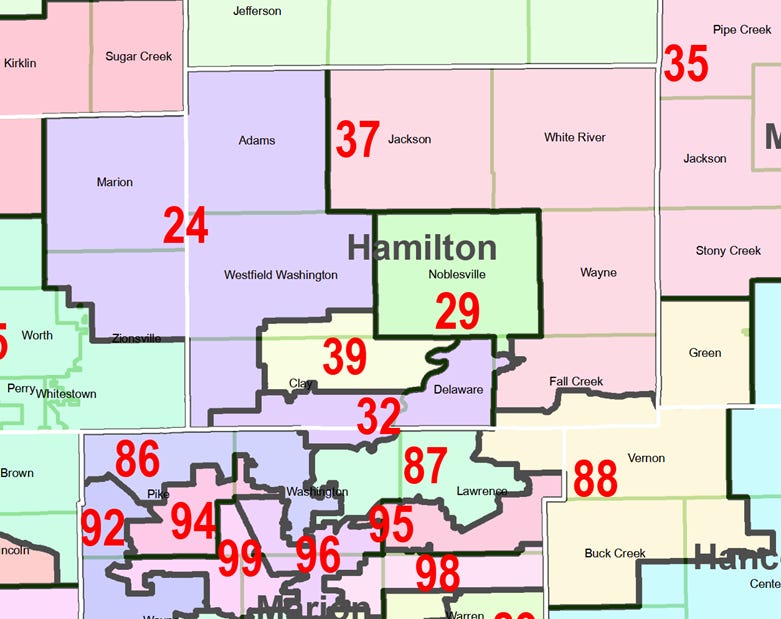
House districts for Hamilton County
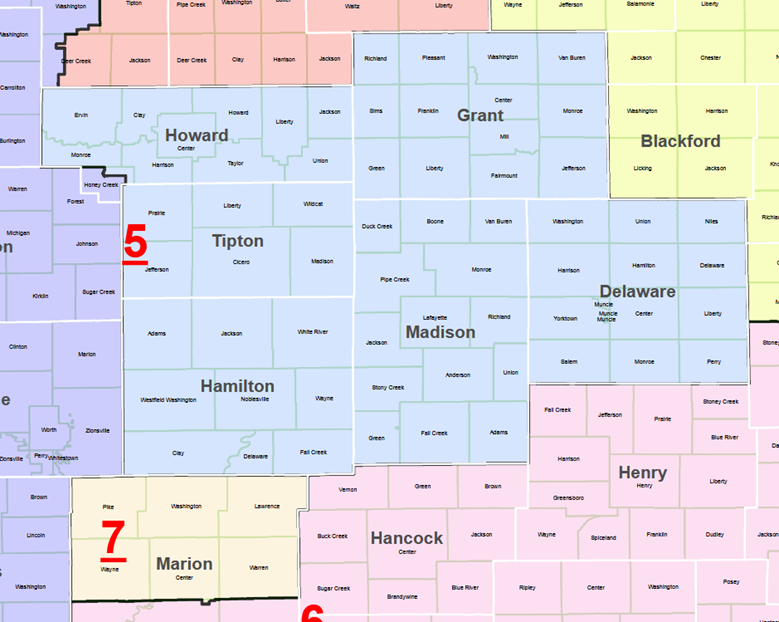
Indiana Congressional District 5
For readers unfamiliar with our corner of Indiana, Hamilton County includes the northern portion of the suburban ring around Indianapolis. Sixty years ago, Hamilton County was nearly all farmland, but the southern half of the county now contains about 250,000 suburban residents. Carmel, Fishers, Westfield, and Noblesville are the major cities. The northern half of the county is still mostly rural, but relentless suburban sprawl is expanding northward. Like many midwestern suburbs, our county is about 80% white middle-class and upper-class households.
For the Indiana House, Fishers is split between three house districts. Fishers is made up of Delaware and Fall Creek townships. District 32 combines west Fishers with south Carmel and a small area of north Indianapolis. The Carmel portion includes many very wealthy households who are major Republican backers. Mike Pence lives there. District 37 combines most of east Fishers with three rural townships to the north that have strong Republican roots. District 88 takes a portion of east Fishers and part of urban Marion County, and combines it with three rural townships to the east. It’s difficult to see this map and not conclude that Fishers has been intentionally broken up by the Republican legislature.
Victoria Spartz, a Republican, currently holds the fifth congressional district shown above. Hamilton County is combined with five rural counties to form the district. Hamilton County has been voting in recent elections with a small Republican margin and likely qualifies as a “purple” county today. But it is very difficult for a Democratic candidate to win in the other five counties in district 5, which lean heavily Republican. Non-MAGA Hamilton County voters have been disenfranchised through combination with these rural counties.
Drawing districts is difficult. There are no perfect answers, and the demographics of districts change constantly. But we would like to see a districting process that is more fair and less partisan. The legislature should better reflect Hoosier voters, with the same diversity that is present across the state. There should not be a dominant super-majority by any party, and there should be more racial and cultural diversity in the Statehouse.
The current district maps leave us with many questions.
Why do Fishers, Carmel, and other suburban cities not have their own representatives?
Should suburban cities be grouped together, rather than broken up with rural townships?
How should we conduct redistricting to promote alternative voices rather than suppress them?
What should we do to make our districts fairer before the next US census in 2030?
District definition is a critical process to sustain democracy in Indiana and around the country. It is a badly broken process today, having suffered decades of abuse by both parties in many states. We want a future that eliminates gerrymandering, whether for partisan advantage, racial oppression, or any other reason. Gerrymandering is wrong, and it must stop.
By Phil
Notes
https://www.census.gov/quickfacts/fact/table/hamiltoncountyindiana/PST045224